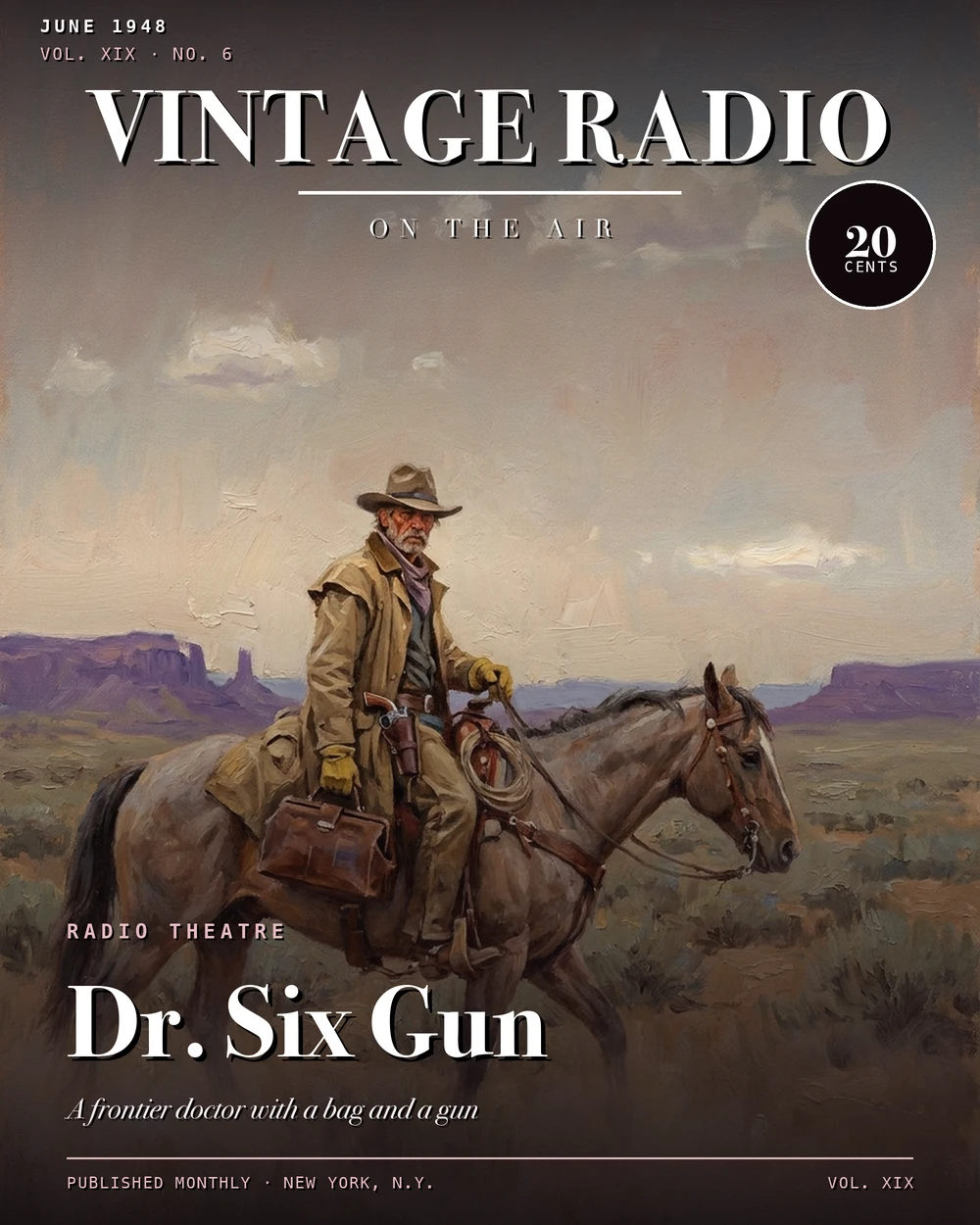
Dr. Six Gun
The Doctor Who Carried a Gun
Dr. Six Gun ran on NBC from September 2, 1954 to October 13, 1955 — a single-season Western built around one of the more unusual character concepts in old-time radio. Karl Weber played Dr. Ray Matson, a frontier physician who traveled the Indian Territory of the 1870s, treating patients on both sides of the racial divide and dispensing justice when the law was nowhere to be found. The character was known to everyone as "Dr. Six Gun," a name that said something about the territory he worked in: mercy and force traveled together. His home base was a small town called Frenchman's Ford, though the show's stories took him across a landscape where almost anything could go wrong.
What gave the show its texture was the supporting cast around Weber. Bill Griffis played Pablo, a gypsy sidekick who also served as the show's narrator — the voice threading the stories together. Pablo was described as perpetually inebriated, which gave the character a comic edge alongside the storytelling function. Pablo also kept company with a talking raven named Midnight, which was either charming or absurd depending on your taste, and probably a bit of both. The combination of a morally serious lead character and an unreliable, raven-accompanied narrator was an odd one, and it gave Dr. Six Gun a flavor that set it apart from the more straightforward Westerns of the period.
The People Behind It
The series was produced by Fred Weihe and directed by Harry Frazee, with music by Art Ryerson and announcements by Fred Collins. The writing fell primarily to Ernest Kinoy and George Lefferts, two NBC staff writers who had worked together before. They had collaborated on Dimension X and then on Rocky Fortune, the Frank Sinatra drama that ran on NBC from October 1953 through March 1954 — immediately before Dr. Six Gun launched. The two writers essentially carried their working relationship from one series directly into the next.
Kinoy had joined NBC as a staff writer in 1948 after graduating from Columbia University and stayed through 1960. Lefferts had been with NBC Radio since 1946 and had a longer list of series behind him, including NBC University Theater, Dimension X, and Best Plays. Both went on to significant careers after radio. Kinoy co-wrote the second episode of the television miniseries Roots and won an Emmy Award for it in 1977. He later served as president of the Writers Guild of America East. Lefferts won three Emmy Awards of his own, along with two Golden Globes and a Peabody Award for Biographies in Sound on NBC.
The guest cast across surviving episodes drew from the reliable pool of New York radio actors. Santos Ortega, Joe DeSantis, Kenny Delmar, Luis Van Rooten, Ralph Bell, and Cameron Prud'Homme all appeared in different episodes. William Keene showed up repeatedly throughout the fall of 1954, making him something of a recurring presence even without a standing character role.
Karl Weber
The show rested on Weber, and he had the background to carry it. Born in Columbus Junction, Iowa on March 17, 1916, he studied at Cornell College and the University of Iowa and spent time performing with Shakespearean troupes in the Midwest before moving to New York. In the late 1940s he co-founded the New Stages off-Broadway group and helped bring Jean-Paul Sartre's The Respectful Prostitute to American audiences — a production that later moved to Broadway. His other Broadway credits included The Land of Fame and Lady Behave.
On radio, Weber had played Dr. Ross Boling on The Guiding Light from 1949 to 1951 and had roles on The Woman in White, The Strange Romance of Evelyn Winters, and The Romance of Helen Trent. He knew the medium well by the time Dr. Six Gun came along. In film, he appeared in the 1952 thriller Walk East on Beacon! as FBI agent Charlie Reynolds. Television work followed across Perry Mason, Dr. Kildare, Maverick, Studio One, and other series. His longest-running TV role was Arthur Tate on the soap opera Search for Tomorrow, which he played for over 500 episodes. In later years he narrated more than 200 audiobooks for the American Foundation for the Blind's Talking Book program and served as president of the New York chapter of the Screen Actors Guild from 1968 to 1969. He died in Boston on July 30, 1990.
How the Run Went
The show aired Thursdays at 8:30 through September 1954, then shifted to Sundays at 8 — a move that happened in late September or October of that year. It stayed in that Sunday slot through April 21, 1955, then went off the air. It returned on August 18, 1955, back in a Thursday slot at 8, and ran through October 13 of that year. The series was a sustaining production, meaning NBC aired it without a commercial sponsor backing it. That was not an unusual arrangement for the period, but it did place the show's continued existence entirely in the network's hands rather than an advertiser's.
An audition or pilot recording dated August 5, 1954 — predating the September 2 premiere — suggests the show went through at least a pre-broadcast tryout phase. The series ran to approximately sixty episodes in total, and more than twenty-five are known to survive.